
Journalistic Malpractice: Globe and Mail Version
Canada's paper of record gets basic facts about the Henry Nowak murder wrong, in the cause of pushing censorship (2000 words, 9 minutes).

The Globe and Mail carries this weekend an op-ed by Doug Saunders, a senior foreign correspondent, blaming Elon Musk and X for riots against discriminatory policing in England (link on image). Saunders’s article is based on obvious factual errors about the murder of Henry Nowak. The present substack unpacks these errors, and points to the larger pattern of which they are part.
The headline contains the obvious desired takeaway: Elon Musk and X need to be censored, or else Canada will face violence next. The government is currently implementing social media restrictions, and The Globe knows that.

I have written several pieces here entitled “Journalistic Malpractice: Prominent Paper Edition”, most recently on The Economist and on The Atlantic. Like those journals, The Globe is prominent, prestigious, and can no longer be trusted to get basic facts right. I wrote a couple of years ago about examples of Globe errors I had seen with my own lying eyes, here. The Globe continues to provide examples of journalistic malpractice.
The Globe has recently climbed down on some of their more lurid errors, notably surrounding the claim that bodies of murdered children were found at the old Kamloops Indian Residential School in BC. But even there, it took five years to acknowledge that there was no evidence for such claims. Others got there in months. On most issues, The Globe remains as woke as ever. And the adjective “woke” is appropriate: the problem is not just the ideology, it is the willingness to misrepresent facts in the service of that ideology.
The Globe and Mail, once pilloried as The Old and Male, is now better called the Woke and Mail. It is the national paper of record, The Times of Canada, as it were, read and trusted in boardrooms and politicians’ offices, and also in the offices of other media. This makes its errors important. They point to a polluted information environment, in which basic facts are obscured by large quantities of falsehood protected by the rhetoric of “racism.”
The Globe’s Basic Errors
Saunders accuses Elon Musk of "promoting racist fictions from the political fringe," focusing on Musk's tweets about the murder of Henry Nowak. The words “racist” and “fringe” are doing a lot of work there, but let’s start with Saunders’s fictions.
Here is Saunders’s third paragraph:

Rioting in Southampton lasted for one night and was not, by recent standards — including the standards by which The Globe judges Antifa and BLM riots —particularly violent. It was prompted by the release of a horrific video (see The Guardian story below) of the death of Henry Nowak. Saunders does not say which international incident he refers to. To blame Elon Musk for popular anger is absurd. Even more absurd is the adjective “race”, when protests against two-tier racialized policing are directed against racial discrimination.
It has just taken a paragraph to unpack the falsehoods that Saunders put into the first sentence.
Nowak was murdered by a Sikh using a supposedly ceremonial sword or dagger that also turned out to be a very effective weapon, a fact not mentioned by Saunders. The Sikh then accused the victim of making racist comments, and the police went right for the distraction. The Guardian, hardly a right-wing source, carries video and an account of the whole outrage, here.
Here, by contrast, is Saunders's account of the murder.
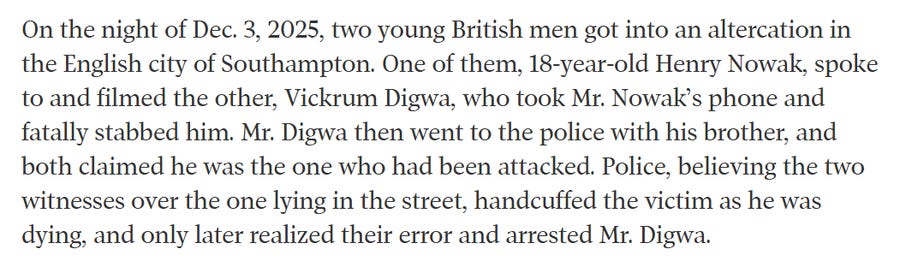
No sword, no stabbing, and no allegation of racism make it into The Globe’s bowdlerized version of the event. It was “an altercation,” as though two young guys got into a fist fight outside a pub.
After emphasizing the allegedly British character of the two men — everyone is equally British, he insists — Saunders goes on:
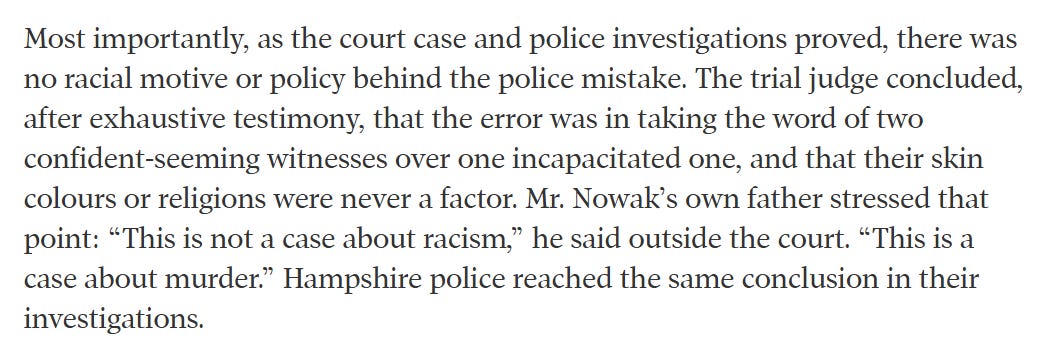
The assertion that no racial policy was involved is clearly false: the police believed a non-white man making a claim of racism, and ignored a white man bleeding to death. The Hampshire police force has explicitly embraced Critical Race Theory “equity” doctrine,1 on which training is mandatory for all officers.2 In this context, training means obedience, and questions, let alone dissent, would be career-ending. This was policy in action.
As for the Hampshire Police investigations, there was a time when Globe reporters did not trust the police to investigate themselves. Clearly, the media has changed sides, and now runs with official versions.
It is now known that the Nowak family made statements under pressure from a Home Office unit known as the Research, Information and Communications Unit (RICU - there is always an acronym), a unit tasked with managing public opinion. Information about this previously obscure security state organization emerged only after Prime Minister Starmer and many other establishment figures had spent several days leaning on the family’s wishes, wishes they were fed by the state.3
The Globe’s correspondent recites the officially concocted line about the family’s feelings as though it were authentic. Just as journalists used to question police narratives, they used to question politicians. Establishment papers increasingly pull together with establishment politicians. It’s a widespread phenomenon, pointing to the semi-official class character of the legacy media.
The penultimate paragraph continues with the howlers:
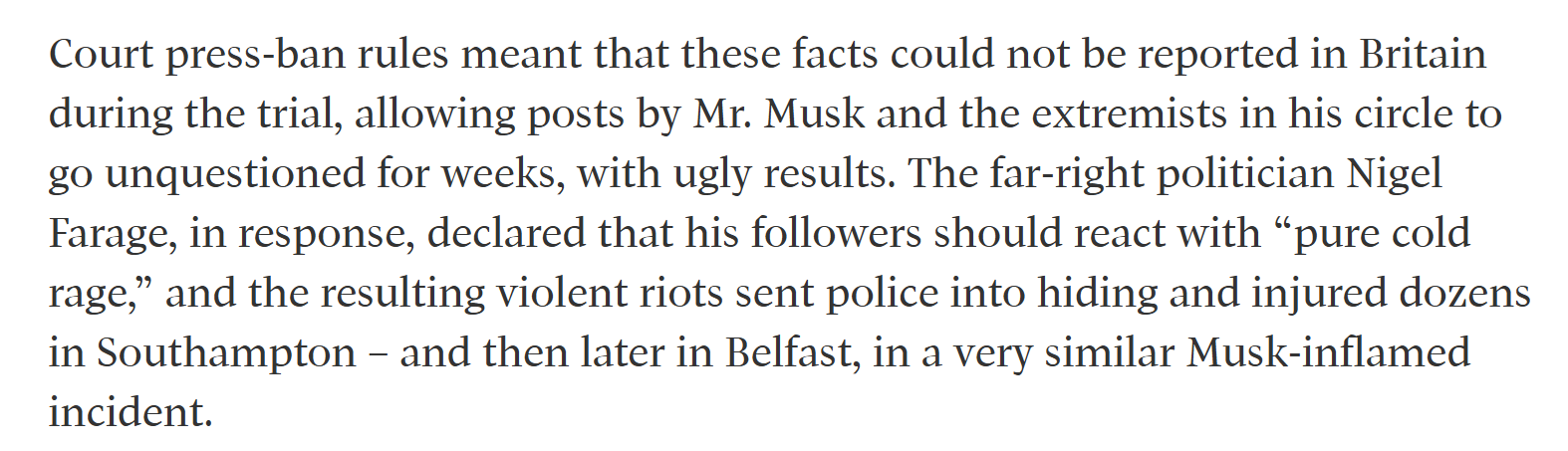
Elon Musk (ht Grok) first posted about the Nowak murder in response to a BBC article on trial testimony on 21 May 2026 (here). So much for “court press ban rules.” Starmer only commented when the body cam footage emerged, hardly Musk’s fault, though indicative of official disquiet. And there is no evidence that the Southampton rioters were Farage’s followers or were reacting to his words, beyond post hoc, propter hoc. Pretty obviously, the word “cold” is calling for determination, not violence.
But most telling is the final sentence on Belfast. An illegal immigrant from the Sudan had tried to behead a man in the street. Saunders of course cannot mention an illegal immigrant; The Globe style guide prohibits it. Musk’s own reaction was more reasonable, unless one favours beheadings:

The Obsession with Race
The contention that race riots were caused by Elon Musk's tweets relies upon the adjective “race”, sliding in there with the assertion that opposition to two-tier policing is racist. Clearly, it would be easy to oppose two-tier policing on anti-racist grounds, just as those who support race-conscious policing also imagine themselves anti-racist, and honestly believe that they are doing good. This article needs the accusation of racism too much to acknowledge any of that.
Saunders denounces the idea of two-tier policing as having no basis in reality, his evidence being a high “stop and search” rate for black people, a fact that may be explained by culture or behaviour. In any case, it doesn’t negate obvious cases of anti-white, anti-Christian, and anti-working-class prejudice. The current protests have more to do with immigration than with race, but Saunders needs his distractions.
Much popular anger against two-tier policing focuses upon police inaction in the face of Islamic violence, coupled with vindictive crackdowns on white protest. The prison-in-a-week Southport crackdown was real enough, as was the police ban of Maccabi Tel Aviv fans from Birmingham for fear of Muslim violence, as were the several arrests of Tommy Robinson. Lucy Connolly and Peter Lynch were both jailed in the context of the Southport riots, Connolly over a tweet and Lynch for shouting at the police. The Globe has reported on neither case, nor any of the other matters mentioned.
Many of the worst incidents of two-tier policing occurred (assuming they are over) in the context of the grooming or rape gang crisis. Girls escaped from rape gangs, and were discouraged from filing charges, or even returned by the police to their tormentors. The Globe has yet to report on the Rape Gang Inquiry (the report is here), and has only touched on grooming gangs in passing, so Globe readers will be left in the dark, unless they also use X.
The word “race” and close cognates run through the Saunders article. Apparently, it is only “white supremacist extremists” who complain about two-tier policing, about mass immigration and illegal immigration, or about rapid demographic and cultural change for which no one voted. “White supremacy” used to name systems based upon legally enforced racial hierarchies, as in Apartheid South Africa. The term has undergone such an extreme semantic expansion that it can now encompass even opposition to the erasure of traditional English culture. I detail this at greater length, and with more footnotes, here:
Hegemony and "White Supremacy"

“White Supremacy” is much with us. Here is a chart from Google’s Ngram viewer, tracking occurrences of the phrase in Google books. The chart ends in 2019, the year before the 2020 BLM riots, so we may expect any update to show a further spike in “white supremacy”:
But Saunders finds the accusation of “white supremacy” and “race hate” motivating, and also a useful argument for censorship, not well hidden in his final paragraph:

Again, the factual problem: Elon Musk has called for protest, but not violence, and Saunders provides no evidence of calls for violence. A journalist, never mind an editor, ought to have caught that.
As for “race-hate fictions,” Saunders own article rests upon many fictions, the most calumnious being that “race-hate” motivates those who oppose cultural and demographic change. It is an error that speaks, however unintentionally, of Saunders’ own worldview, where there are no possible grounds other than racism for the defence of English or British culture, or for opposition to rapid change imposed from above. Saunders and his ilk hate more than they realize, or can admit.
The Minimization of Offline Reality
The other problem with Saunders’s article is the presumption that protesters, most of whom are not violent, are motivated by social media, and not by the obvious street-level reality of demographic change and two-tier policing. A certain amount of reality can be constructed online, but no influencer, even with Musk’s 200 million followers, can tell people to ignore the evidence of their eyes, or make them hallucinate problems they cannot see. If mass immigration had few bad consequences, no claims on social media would provoke protest.
Many people post alarming things on X. Those that command recognition, that have a popular resonance, never mind command political support, usually have some valid material basis. In an exercise in shooting the messenger, The Globe is trying to blame real social problems caused by policies it favours on Elon Musk, with the obvious intention of censoring X.
Censorship can hide reality, but only for a while. The commercial interests of the legacy media may be served by censoring alternatives, and certainly there is anxiety in elite media circles about the loss of narrative control, often finding expression in the language of “misinformation.” Self-interest creates the apparently paradoxical situation where the press supports censorship.
Saunders's article is an op-ed, so some interpretive latitude is allowed. But Saunders is a senior journalist, and he gets too many facts wrong. He is laundering the uncomfortable story of the Nowak murder, and constructing a reassuring and also a useful narrative for his well-heeled audience, feeding anti-Musk and anti-X talking points to censorship policy makers and to their institutional supporters. Saunders and his editors have been around too long to not know what they are doing.


I’m surprised The Glob And Snail is still around. All their writers are either leftist faggots or neurotic old women. I think they survive by pandering to old geriatrics and maybe the odd retard? Who knows.
The Globe was such a great paper. Sad that it turned into a lame woke rag.